Victoria · Corporate CBD offices and professional services floors
Why Melbourne Offices Are Replacing Snack Machines With Smart Fridges
Published 8 August 2026 · 1,240 words
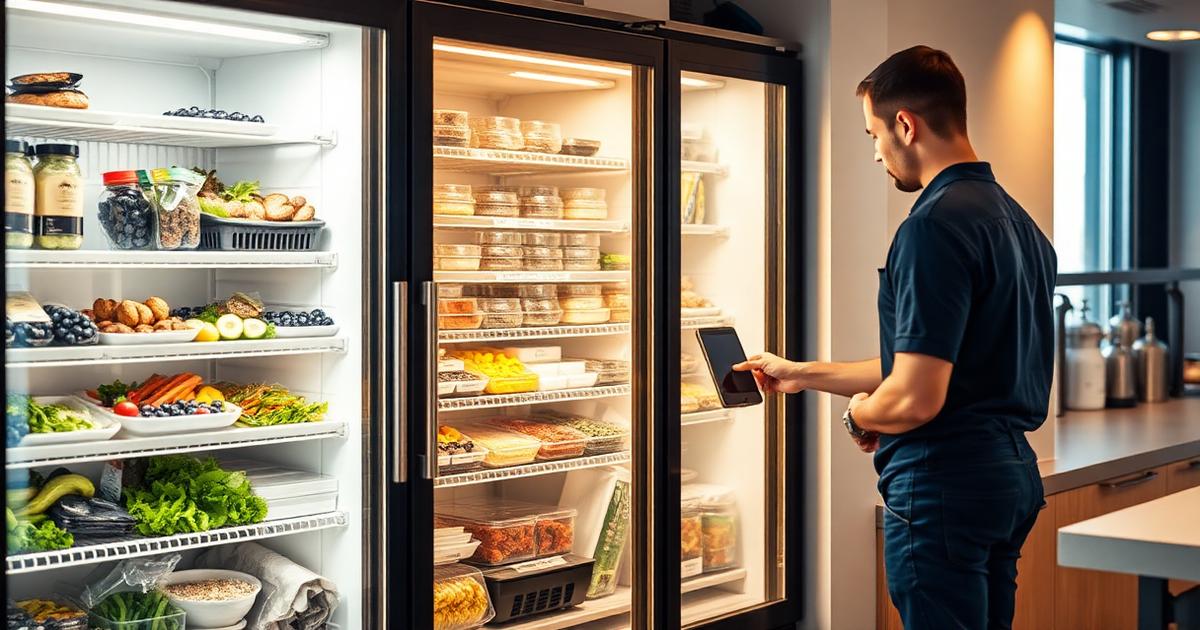
The short answer
Melbourne corporate offices are moving from spiral snack machines to smart fridges because the fridge sells what hybrid office workers actually want at lunchtime: fresh meals, salads, yoghurt, protein and cold drinks, bought with a tap and no coin mechanism. A smart fridge occupies a similar footprint, runs on a standard 240V outlet, and under $0 COST hire it is supplied, installed, stocked and serviced by a local owner-operator at no charge to the tenancy.
Walk a dozen floors of Collins Street, Docklands or Southbank and the change is obvious. The tall glass box of chips and chocolate is still there in older tenancies, but in refurbished Melbourne offices it has increasingly been replaced by a glass-door fridge holding sandwiches, salad bowls, sushi, yoghurt, cold-pressed juice and protein snacks — unlocked by tapping a card and charged automatically on the way out. This is not a fashion cycle. It follows a specific shift in how Victorian office floors are used since hybrid work settled, and it changes the maths for facilities managers who are trying to keep people on site through the middle of the day. This guide sets out what a smart fridge is, how it differs from a traditional machine, what it needs from your tenancy, and how the $0 COST hire model applies in Melbourne.
What exactly is a smart fridge in a workplace?
A smart fridge is a refrigerated cabinet with a locked glass door, a card reader and either a camera-and-weight sensing system or RFID tagging on the products. The user taps a card or phone to unlock the door, takes what they want, closes it, and the system charges for what left the shelf. There is no selection keypad, no spiral, and no dropped item at the bottom of a chute.
The practical difference for Melbourne offices is what that mechanism allows on the shelf. A spiral machine constrains you to packaged, drop-tolerant products. A smart fridge takes a fresh salad bowl, a wrap, a sushi pack, a yoghurt or a cold pasta without damaging it, which is exactly the price point and product set that keeps someone in the building rather than queuing on Little Collins Street.
The commercial mechanism is unchanged. Under $0 COST hire there is no purchase price, no lease, no rental, no insurance charge and no service fee. A local vending machine owner-operator supplies, delivers, installs, stocks and services the unit and earns from product sales.
- Tap-to-open glass door with automatic charging on close
- Handles fresh food that a spiral machine physically cannot
- No coin mechanism, no notes, no cash handling by your team
- Product range reviewed against real sales data, not guesswork
- Supplied, installed, restocked and serviced under $0 COST hire
Why is the change happening in Melbourne right now?
Three things converged. Hybrid attendance concentrated Melbourne office occupancy into Tuesday to Thursday, which makes the midday peak sharper and the queue outside a CBD food outlet longer. Cash disappeared from Victorian workplaces almost entirely, which removed the last argument for a coin-operated unit. And the price gap between a food-court lunch and a fridge-stocked meal widened enough that staff notice it weekly, not occasionally.
There is also a floor-planning factor specific to refurbished Melbourne tenancies. Modern fit-outs consolidate amenity into a single social hub — kitchen, coffee point and seating together. A glass-front fridge belongs in that hub visually in a way that a large branded snack machine does not, so it survives the design review that the older machine fails.
None of this makes the traditional machine obsolete. In a Truganina distribution centre or a Dandenong South plant running three shifts, a robust combo machine full of drinks and shelf-stable snacks is still the better answer. The shift is specific to corporate floors in Victoria where fresh food is what people are leaving the building to buy.
How do smart fridges and snack machines compare?
The honest comparison is a trade: the fridge wins on range and experience, the combo machine wins on resilience and on sites with lower or less predictable traffic. Fresh stock has a shelf life, so a smart fridge needs enough daily foot traffic to turn product over before it is rotated out.
- Both units need roughly one square metre and a standard 240V outlet
- Both are fully cashless with Visa, Mastercard, Apple Pay, Google Pay and QR
- Fresh ranges need enough daily traffic to turn stock over
- Combo machines tolerate irregular traffic and overnight shifts better
- Many Melbourne sites end up running one of each in different zones
| Factor | Smart fridge | Snack & drink combo machine |
|---|---|---|
| Typical range | Fresh meals, salads, sushi, yoghurt, drinks | Chips, chocolate, bars, cold drinks |
| Payment | Tap to open, charged on close | Tap-and-go, QR, mobile wallet |
| Footprint | About one square metre | About one square metre |
| Power | Standard 240V outlet, refrigerated | Standard 240V outlet, refrigerated |
| Best suited to | Corporate floors with a steady midday peak | Shift sites, warehouses, 24/7 access areas |
What does a smart fridge need from your tenancy?
Very little, and the list is the same one you would prepare for any machine placement. The unit is about 1000mm wide, 900mm deep and 1830mm tall, so roughly one square metre of floor space with clearance for the door swing and airflow behind it. It plugs into a standard 240V general power outlet — no hard wiring, no plumbing unless you add a coffee unit alongside.
In Melbourne CBD towers the real constraints are logistical rather than technical. Grade A buildings want a loading dock booking and a certificate of currency from the installer, and some restrict deliveries to before nine or after four. Getting building management to confirm dock access early is generally the difference between an install this week and an install in a fortnight.
Running cost sits with electricity and nothing else. A refrigerated unit draws roughly 1.2–2.5 kWh a day, which is about $0.35–$0.80 depending on your Victorian tariff. There is no service charge, no restocking fee and no minimum spend from the business.
- Roughly one square metre of floor space in a visible, walkable spot
- Standard 240V outlet within reach of the machine
- Trolley or goods-lift access for delivery and restocking
- Dock booking and installer insurance handled by the operator
- Electricity is the only cost the tenancy carries
Which Melbourne workplaces qualify for $0 COST hire?
Placement is driven by daily foot traffic rather than headcount on paper. Sites from about 15–20 staff on site each day typically qualify, and for a fresh-food fridge specifically the operator will look at whether that traffic is consistent across the week rather than concentrated in a single day.
That covers most professional services floors in the Melbourne CBD, Docklands and Southbank, along with health, education and government sites across Victoria. Where a floor is too quiet on its own, buildings often qualify by consolidating amenity into a shared end-of-trip or ground-floor area used by several tenancies.
If the site turns out not to suit either party, the machine is removed free of charge — with the honest caveat that a placed machine does need to make sales to stay. That is the whole risk profile for the business: a square metre of floor space and a power point.
Should you replace the snack machine or run both?
For most Melbourne corporate floors, the answer is both, in different zones. Put the smart fridge in the social hub where people eat, and keep a combo machine near the lifts, the print room or a late-shift area where the demand is a cold drink at four in the afternoon rather than a lunch.
If floor space genuinely allows only one, choose on what people currently leave the building for. If it is lunch, the fridge is the better unit. If it is an afternoon energy drink or a chocolate bar, the combo machine will outperform it and cost less to keep interesting.
Either way the decision is reversible. Because there is no lease and no lock-in contract, changing the machine type after a trial period is a conversation with your operator, not a variation to an agreement.
How quickly can a Melbourne site be installed?
Once the site is confirmed and building access is sorted, installs in Melbourne are commonly booked within a few working days. The operator delivers, positions and levels the unit, connects it to power, tests the payment terminal and loads the first planogram with you.
Range changes after that are driven by sales data. Most sites make one meaningful adjustment in the first month, usually adding more of whatever sold out and removing the two lines nobody touched, then settle into a stable range.
Frequently asked questions
What is the difference between a smart fridge and a vending machine?
A vending machine dispenses a selected item through a spiral or lift mechanism, so products must survive the drop. A smart fridge has a locked glass door that unlocks when you tap a card, and it charges automatically for what you remove. That lets it stock fresh meals, salads, sushi and yoghurt that a traditional machine cannot handle.
Does a smart fridge cost a Melbourne office anything to install?
No. Under $0 COST hire there is no purchase price, lease, rental, insurance or service fee. A local owner-operator supplies, delivers, installs, stocks and services the fridge and earns from product sales. The tenancy provides roughly one square metre of floor space and a standard 240V outlet, and staff pay only for what they take.
How much power does a smart fridge use?
A refrigerated unit typically draws around 1.2–2.5 kWh a day, which works out to roughly $0.35–$0.80 depending on your Victorian electricity tariff. That is the only ongoing cost carried by the site. Placement in a cooler spot away from direct sun and with clear airflow behind the unit keeps consumption at the lower end of that range.
What happens to fresh food that does not sell?
The operator rotates stock as part of the regular service visit and removes anything approaching its date. Ranges are reviewed against sales data, so lines that consistently do not move are replaced with items your floor actually buys. Waste is the operator's cost, which is why they will size the range to your real daily traffic rather than overfilling the unit.
How many staff does a Melbourne site need to qualify?
Sites from about 15–20 staff on site each day typically qualify. For a fresh-food fridge the operator also looks at how evenly that traffic spreads across the week, since hybrid attendance concentrates Melbourne offices into the middle of the week. Quieter floors often qualify by sharing a machine in a common area.
Can we keep our existing snack machine as well?
Yes, and many Melbourne offices do. A smart fridge in the kitchen or social hub covers lunch, while a combo machine near the lifts or a late-shift area covers drinks and snacks outside the midday peak. Both run cashless and both sit under the same $0 COST hire arrangement.
Key claims, checked against sources
A refrigerated snack-and-drink combo machine draws about 1.2–2.5 kWh per day, so electricity is the only running cost the host site carries.
The machine plugs into a standard 240V general power outlet — no three-phase supply, plumbing or data cabling is required.
Sites from about 15–20 daily staff typically qualify for $0 COST hire placement through a local owner-operator.
Sources and further reading
- Free Vending Machines Melbourne — smart fridge vending
- Compare vending machine types
- Vending machine power consumption guide
- Melbourne placement coverage
- Free Vending Machines Melbourne — $0 COST placement