Victoria · warehouse and distribution centre managers
Installing Vending Machines for Warehouses Melbourne Sites Need
Published 18 August 2026 · 1,006 words
The short answer
Logistics managers can secure modern food and drink vending machines for warehouses Melbourne wide through a $0 COST hire model managed by local owner-operators. With no rental or maintenance fees, warehouses only provide 1sqm of floor space and a standard 240V power outlet. This solution keeps multi-shift workers on-site, hydrated, and energized across industrial precincts in Victoria.
Managing high-throughput logistics facilities across Truganina, Altona, Dandenong South, and Campbellfield demands continuous operational efficiency. When operating multi-shift rosters, keeping warehouse operators, forklift drivers, and pack-and-ship personnel energized and focused is a constant challenge. Sourcing reliable vending machines for warehouses Melbourne logistics hubs can transform shift productivity by eliminating long off-site food runs during break periods. Dust, ambient temperature fluctuations, heavy foot traffic, and continuous operations mean standard workplace refreshment solutions often fall short. A tailored automated refreshment program managed by local Melbourne operators ensures staff access chilled drinks, energy boosters, and hearty snacks around the clock at zero cost to your facility budget.
Why choose vending machines for warehouses Melbourne facilities operate?
Warehouse operations across Melbourne run on tight, time-critical schedules. When break times arrive, workers often face a restrictive choice: spend fifteen minutes walking or driving to the nearest convenience store or milk bar, or settle for whatever remains in an uninspired breakroom cabinet. By placing automated vending machines for warehouses Melbourne industrial sites can instantly bridge this convenience gap without capital expenditure.
Under a $0 COST hire agreement, facility managers gain full access to top-tier commercial food and beverage equipment without purchase costs, monthly leasing fees, or service expenses. A dedicated local Melbourne owner-operator manages every operational aspect, including routine stock replenishments, line cleaning, temperature monitoring, and preventative maintenance.
Qualifying industrial sites with 15–20 staff or higher gain access to fully customized drink and snack combinations tailored directly to their crew's physical demands. This arrangement guarantees that night shifts, weekend teams, and early morning dispatch personnel enjoy identical access to cold beverages and energy-dense foods without requiring administrative oversight from operational supervisors.
How do heavy-duty vending machines perform in dusty industrial hubs?
Industrial environments present environmental challenges that standard office vending units simply cannot survive. High ambient temperatures during Melbourne summers, airborne dust from cardboard box handling, continuous pallet movements, and floor vibration from heavy forklift traffic put significant stress on refrigeration compressors and electronic components. Industrial-grade vending machines are engineered specifically to thrive under these rugged operating conditions.
Features such as sealed glass fronts, dust-filtered intake vents, reinforced heavy-gauge steel cabinetry, and high-impact drop sensors ensure consistent operational reliability even in non-airconditioned distribution space. Remote telemetry monitoring allows local operators to track internal temperature stability and stock movement in real time.
Furthermore, modern eco-friendly cooling units inside these machines consume minimal electricity, drawing roughly 1.2–2.5 kWh per day. This energy consumption equates to an estimated daily running cost of just $0.35 to $0.80 for the host facility, making the power contribution negligible compared to the productivity benefits gained.
- Heavy-duty steel casing built to withstand busy forklift bays and high-traffic break corridors.
- Dust-sealed internal electronics and high-capacity refrigeration air filtration systems.
- Remote telemetry providing real-time inventory tracking and automatic fault notifications.
- Energy-efficient refrigeration systems consuming approximately 1.2–2.5 kWh per day.
- Integrated drop-sensor technology guaranteeing successful product delivery or instant credit refund.
How can logistics managers eliminate off-site breaks during shifts?
Unplanned off-site food runs represent a substantial hidden loss in warehouse productivity. When shift workers leave the security perimeter to purchase coffee, energy drinks, or hot meals, short 15-minute scheduled breaks easily stretch to 25 or 30 minutes due to industrial precinct road traffic and long queues at local takeaway shops.
Installing a fully stocked automated canteen inside the main breakroom or near key dispatch offices keeps staff on-site throughout their allocated rest period. By stocking high-protein snacks, electrolyte hydration drinks, ready-to-eat microwaveable meals, and iced coffees, site managers directly support physical endurance across demanding manual labor shifts.
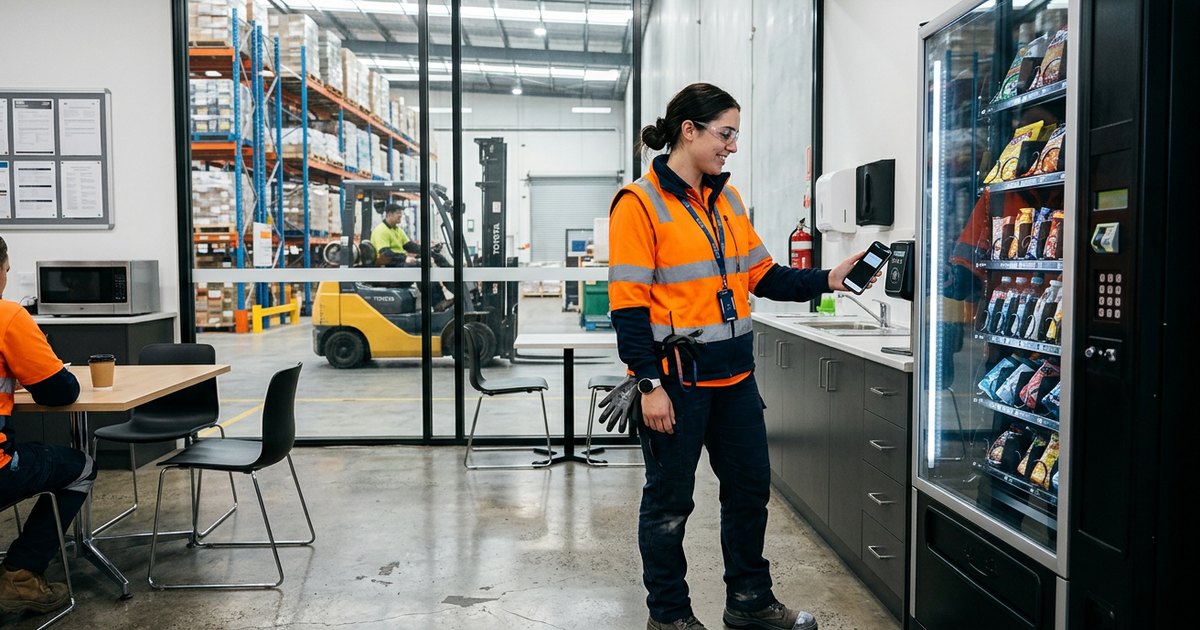
Workers appreciate the convenience of grabbing nutritious refreshments in seconds using contactless card or smartphone payments, while operations supervisors benefit from predictable break durations, safer shift handovers, and reduced pedestrian movement across truck loading aprons.
- Keeps warehouse personnel safe on-site rather than navigating heavy industrial traffic during breaks.
- Provides 24/7 access to hydration, high-protein energy snacks, and fast hot meals.
- Fully cashless payment interfaces supporting Visa, Mastercard, Apple Pay, Google Pay, and QR codes.
- Reduces breakroom clutter and eliminates unhygienic open food storage issues.
- Boosts overall workplace morale and staff retention across afternoon and night shift rosters.
What features matter in vending machines for warehouses Melbourne wide?
Selecting the right commercial vending machines for warehouses Melbourne managers supervise involves prioritizing dispensing speed, payment versatility, and product density. Industrial teams rarely carry physical cash or loose coins on the warehouse floor. Equipping machines with modern payment telemetry enables lightning-fast contactless transactions via credit card, mobile wallets, or smartwatches.
Fast transaction processing eliminates lost sales caused by unreadable banknotes or coin jams, keeping breaklines moving smoothly even when multiple picking teams take scheduled breaks simultaneously.
Product selection must also reflect the physical demands of intensive logistics work. Traditional office setups might focus primarily on light confectionery, but distribution center workers require substantial sustenance. Successful warehouse machines feature a balanced mix of sugar-free energy drinks, iced teas, protein bars, meat snacks, savory nuts, and ready meals alongside popular classic treats. Local operators regularly analyze sales data to cycle out slow-moving stock, ensuring the machine constantly features the brands and products your crew actually wants.
Placement and Power Requirements for Industrial Warehouses
Integrating a commercial vending unit into your Melbourne facility requires minimal floor planning and zero complex infrastructural alterations. Each standard glass-front machine occupies approximately one square metre of floor space, measuring roughly 1000mm wide by 900mm deep by 1830mm tall.
Ideal installation locations include main staff lunchrooms, central break corridors, or covered areas adjacent to central supervisor offices where foot traffic is high and lighting is adequate.
To operate seamlessly, the unit requires access to a standard single-phase 240V power outlet located within two metres of the installation footprint. Dedicated electrical wiring or specialized high-voltage outlets are not required. Operators perform a thorough site safety risk assessment during delivery to ensure machine placement does not obstruct emergency exit routes, pedestrian walkways, or forklift transit lanes, maintaining full compliance with Victorian workplace safety regulations.
Comparing Workplace Refreshment Models for Melbourne Logistics
Logistics managers evaluate several options when seeking to provide food and drink services for site personnel. Traditional self-service micro-markets, leased vending machines, and outsourced catering each come with distinct capital costs, liability risks, and management overheads.
The comparison table below outlines how the $0 COST hire owner-operator model compares directly against traditional workplace refreshment alternatives in industrial warehouse environments.
| Feature / Metric | $0 COST Hire Model | Leased / Purchased Unit | Self-Service Micro-Market |
|---|---|---|---|
| Capital Outlay | $0 upfront investment | $3,000 - $12,000 purchase | $5,000 - $20,000 setup |
| Maintenance & Repairs | 100% covered by operator | Paid by facility owner | Paid by facility owner |
| Stocking & Service | Managed by local operator | Internal staff required | Internal staff required |
| Theft & Shrinkage Risk | Zero risk (locked unit) | Zero risk (locked unit) | High risk (open shelves) |
| Power Requirements | Standard 240V outlet | Standard 240V outlet | Multiple 240V outlets |
Frequently asked questions
How much does it cost to install vending machines for warehouses in Melbourne?
Installing a warehouse vending machine in Melbourne is completely free under a $0 COST hire agreement. There are no upfront equipment costs, monthly delivery fees, leasing expenses, or maintenance charges. The local owner-operator supplies, installs, stocks, and services the machine at their own expense, generating revenue solely from product sales to your shift workers.
What minimum site requirements must a Melbourne warehouse meet to qualify?
Most facilities with 15–20 staff members or regular daily foot traffic qualify for a $0 COST hire machine. The warehouse only needs to provide roughly one square metre of clear indoor floor space (1000mm W x 900mm D x 1830mm H) near a standard 240V single-phase electrical outlet.
How much electricity does a warehouse vending machine consume daily?
Modern refrigerated snack and beverage vending machines consume approximately 1.2–2.5 kWh per day. Based on typical Melbourne commercial electricity tariffs, this amounts to roughly $0.35 to $0.80 per day in running costs, making it an exceptionally low-power facility amenities addition.
What payment options are supported on modern Melbourne warehouse vending machines?
All machines are equipped with modern cashless payment terminals. Staff can pay instantly using Visa, Mastercard, debit cards, Apple Pay, Google Pay, and QR code digital payments. Cashless technology ensures fast break room throughput without coin jams or cash handling issues.
What happens if a vending machine breaks down or runs out of stock?
A local Melbourne owner-operator monitors machine stock levels and technical performance remotely via integrated telemetry systems. If a fault occurs or stock runs low, the operator responds promptly to restock or repair the machine at zero cost to your facility.
Can we customize the snacks and drinks stocked in our warehouse machine?
Yes, product selections are customized to match worker preferences. Operators stock popular cold beverages, energy drinks, protein bars, ready meals, and traditional savory or sweet snacks, continuously tailoring product lines based on real-time shift sales data.
What occurs if our Melbourne facility layout changes or the machine is no longer needed?
If your logistics facility relocates, reconfigures floor space, or finds the unit no longer meets site requirements, the local operator will relocate or remove the machine free of charge without financial penalties or complex contract cancellations.
Key claims, checked against sources
A refrigerated snack-and-drink combo machine draws about 1.2–2.5 kWh per day, so electricity is the only running cost the host site carries.
The machine plugs into a standard 240V general power outlet — no three-phase supply, plumbing or data cabling is required.
Sites from about 15–20 daily staff typically qualify for $0 COST hire placement through a local owner-operator.
Source: Free Vending Machines Melbourne — free vending placement
Sources and further reading
- Free Vending Machines Melbourne — free vending placement
- Vending machine power consumption guide
- Compare vending machine types
- Melbourne placement coverage
- Industries warehouses logistics
- Smart fridges